

When help changes what it helps
The line between supporting capacity and substituting for it
PositiveMinds | Positive Stories | Edition 074
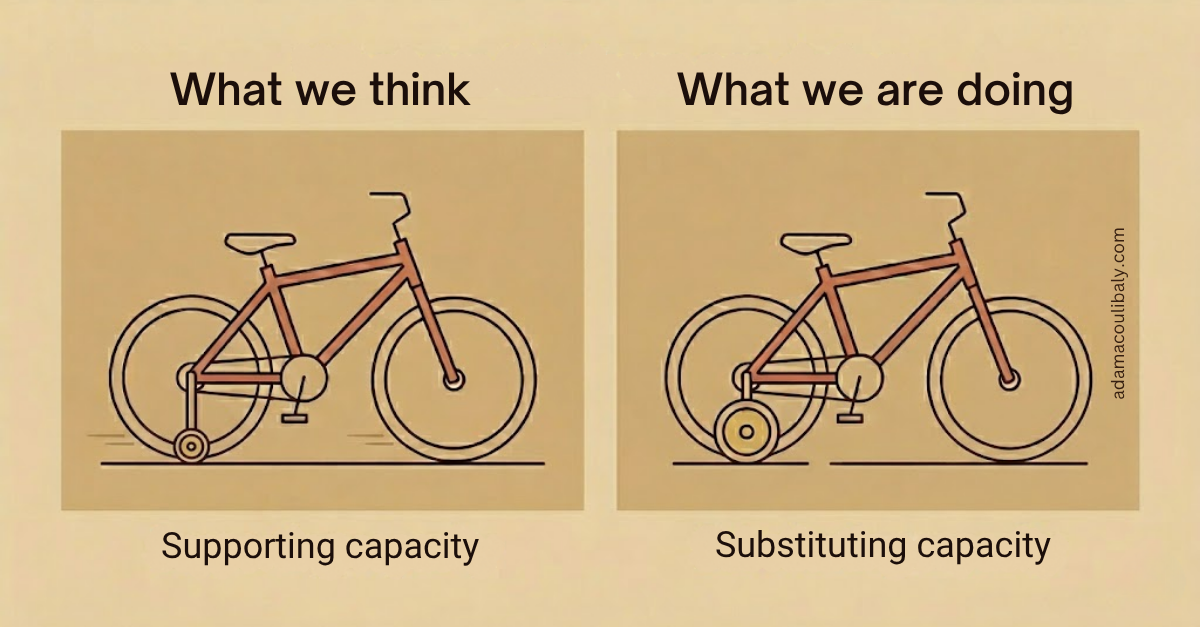
Illustrated by me (A. Coulibaly) with canva.com and Gemini by Google
A bicycle fitted with a support wheel can keep moving while the rider is still learning to balance. That is its role. It is there for a while, then removed once the rider can stay upright without it.
That is how support is often understood in humanitarian and development work. Extra help arrives in moments of strain, fragility, or transition. It is meant to steady movement for a time, reduce the risk of collapse, and create the conditions for local actors to build confidence, judgement, and control.
The problem is not temporary support. The problem begins when what should recede stays in place.
A temporary aid becomes something else when it is not removed over time. The rider continues to move, but part of the balancing is still being done elsewhere. Habits form around that arrangement. Decisions form around that arrangement. What was meant to help local actors gain confidence can quietly begin to prevent them from fully carrying themselves.
This is more common than we often admit.
Temporary support becomes a problem when it stops being temporary.
At its best, temporary support creates room rather than dependence.
Most external support begins for good reason. There is urgency. There are gaps. There are moments when local actors are expected to carry more than any system could reasonably absorb on its own. Funding, technical advice, staffing, coordination, and operating systems are brought in to keep things moving.
At its best, this support is transitional. It absorbs pressure without taking over the underlying function. It creates room for local actors to strengthen their own judgment, make their own adjustments, and take on more of the weight over time. Its purpose is not to remain central. Its purpose is to become less necessary.
That is what makes it support rather than substitution.
The difficulty begins when what is temporary stops receding.
Support remains in place not because anyone formally decided it should become permanent, but because it is useful, familiar, and easier to maintain than to redesign.
Gradually, support starts doing more than reducing pressure. It begins to shape pace, timing, standards, and acceptable ways of working. Local actors continue to move, but within a balance that is still partly being held from outside. Over time, the system learns to rely on that external steadiness.
At that point, the question is no longer whether support exists. The question is whether local actors are becoming more able to judge, adapt, and lead for themselves, or whether dependence is simply being stabilised in a more respectable form.
This shift rarely announces itself.
It takes form through ordinary choices. A reporting format determines what gets noticed. A donor cycle determines when plans must be finalised. A technical model defines what is accepted as sound practice. A coordination structure determines whose judgment carries the furthest.
None of these choices looks dramatic on its own. Each can be defended. Each can improve order and consistency. Yet together they can produce a system in which local actors remain active while the functions that matter most are still held elsewhere.
The issue is not whether people are involved. The issue is who is learning to hold balance, and who continues to provide it.
That is why visibility can be mistaken for strength.
Local organisations may be fully engaged. They may implement programmes, contribute knowledge, sustain relationships, and respond to changing conditions with remarkable skill.
But participation is not the same as carrying the weight of direction.
If key decisions, core resources, accepted standards, and final validation remain outside the local system, then local capacity may be visible without becoming decisive. Movement continues, but the ability to hold balance still depends on something external.
A rider does not learn balance by being kept upright indefinitely. Balance comes through practice, correction, risk, and growing control. The same is true here. If local actors are not given real room to decide, adjust, and absorb consequences, then confidence may grow only within limits set by others.
Local capacity can be visible without becoming decisive.
The risk grows when usefulness becomes permanence.
A support wheel is helpful only if it is removed over time. Its value lies in what it makes possible after it is gone. If it remains attached indefinitely, it ceases to be a learning aid and becomes part of the structure of dependence.
The same applies to external support. When it does not recede, it can begin to reorganise the very capacity it claims to strengthen. Local actors adapt to the support. External actors adapt to being needed. Systems are then shaped around the continuation of that arrangement rather than the transition beyond it.
That is how substitution settles in without always being named.
What matters, then, is not the presence of support alone.
The issue is not whether support should exist. In many contexts, it must. The issue is whether support is designed to transfer weight over time.
Does it create the conditions in which local actors can judge, decide, adapt, and carry more for themselves? Or does it continue to absorb those functions while still being described as support?
The difference matters because both arrangements can look similar from the outside. In both cases, movement continues. In both cases, programmes are delivered. In both cases, results can be reported.
But only one arrangement leaves local actors more able to continue when the extra support is no longer there.
What remains after support recedes is the real test.
A simple test is whether local actors can still move when support begins to come off. Not perfectly. Not without uncertainty. But with enough judgment, balance, and control to continue under their own direction.
If they can, then support has done its work.
If they cannot, then what was described as support may have become substitution long before anyone was willing to say so.
Support has done its work only when local actors can keep moving under their own direction.
