

Taking More, Returning Less
Why aid cannot be separated from the wealth drain out of the Global South
PositiveMinds | Positive Stories | Edition 075
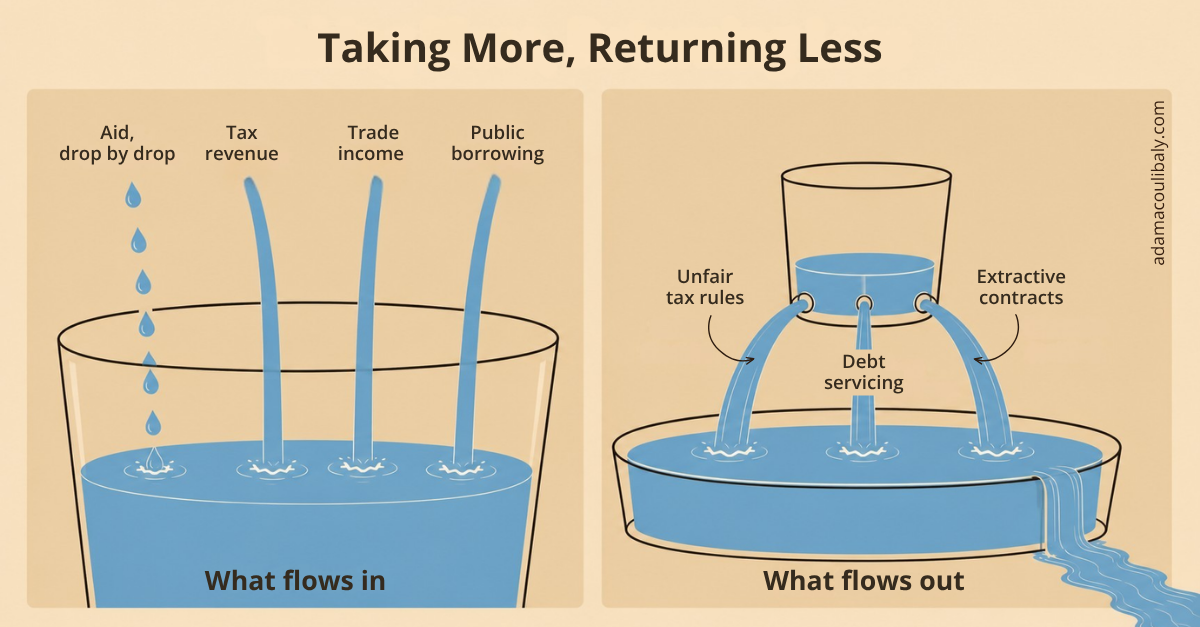
Illustrated by me (A. Coulibaly) with canva.com and Gemini by Google
The dominant narrative about development finance is still too often told as one of generosity.
Aid flows in. Donors give. Recipient countries receive. Advocacy then asks how these flows can be protected, increased, better targeted, and turned into results and sustainable impact.
Part of that story is true. Aid matters. In many places, it saves lives. It supports public services. It protects civic space. It helps communities respond in moments of crisis. It can be the difference between hunger and survival, exclusion and access, silence and voice.
But aid is not the whole story.
The deeper question is not only how much money arrives. It is also how much leaves.
We cannot understand aid honestly if we only count what flows in, and ignore what keeps flowing out.
This is the part the dominant narrative often leaves out. It focuses on the bucket being filled, but says less about the leaks beneath it. It counts official development assistance, but often ignores the wealth leaving through illicit financial flows, unfair tax rules, debt servicing, extractive contracts, profit repatriation and unequal trade.
This is the uncomfortable reality behind many North-South economic relationships: more is taken than returned. And what is returned often comes with conditions attached.
Countries are asked to reform, report, align, comply, prioritise and absorb risk in order to access a fraction of the wealth that has already left their economies. Aid is then presented as support, while the deeper rules that enable extraction remain largely untouched.
UNCTAD’s Economic Development in Africa Report 2020: Tackling Illicit Financial Flows for Sustainable Development in Africa estimates that Africa loses around US$88.6 billion every year through illicit capital flight. That amount is close to half of the continent’s annual Sustainable Development Goals financing gap. This is money that could support schools, clinics, water systems, social protection, climate adaptation and decent jobs.
The Tax Justice Network’s State of Tax Justice 2023 widens the lens. It estimates that countries lose US$480 billion a year to global tax abuse. This includes US$311 billion from cross-border corporate tax abuse and US$169 billion from offshore tax abuse by wealthy individuals.
These figures should change how we talk about funding.
The issue is not only that there is not enough aid. The issue is that far greater amounts of wealth are allowed to leave through rules and practices that are often treated as normal, technical or inevitable.
Research by Jason Hickel, Dylan Sullivan and Huzaifa Zoomkawala adds another layer. In “Plunder in the Post-Colonial Era: Quantifying Drain from the Global South Through Unequal Exchange, 1960–2018”, they estimate that, in the most recent year covered by their study, the Global North appropriated commodities from the Global South worth US$2.2 trillion in Northern prices. Their work points to a long-standing pattern of unequal exchange, in which value continues to flow from South to North.
Oxfam’s own inequality work tells a similar story. Inequality Inc. shows how concentrated corporate power fuels inequality through tax dodging, pressure on workers, privatisation and climate harm. Takers not Makers links today’s extreme inequality to the long history of colonial extraction. Resisting the Rule of the Rich shows how extreme wealth translates into political power, giving a small elite greater influence over public choices.
Seen together, these sources challenge the old aid story.
The Global South is not simply receiving help from the rest of the world. In many ways, it is helping finance the rest of the world. The imbalance is not accidental. It is produced by systems of tax, debt, trade, investment and corporate power that decide where value is created, where it is captured, and who has the power to set the terms.
When more leaves than arrives, aid cannot be presented as the full measure of global solidarity.
This does not mean every country in the Global North benefits equally from this imbalance. It does not mean every government, institution or person in the North supports extractive relations. Some governments, civil society actors, researchers, campaigners and movements are actively pushing for fairer tax rules, debt justice, stronger climate finance, more accountable business conduct, and more equitable partnerships.
That nuance matters.
But nuance should not become avoidance.
The structure remains. The benefits of the current system are not evenly shared, even within the Global North. They often concentrate among powerful corporations, financial centres, wealthy individuals and political interests with the influence to shape rules in their favour.
The costs are also not evenly carried. They fall heavily on people and communities whose public services are underfunded, whose labour is undervalued, whose natural resources are extracted, and whose governments are left with less fiscal space to invest in their own priorities.
This is why advocacy needs a stronger counter-narrative.
It is not enough to ask how aid can be better protected or better spent. We also have to ask why aid is needed on such a scale when so much wealth is being drained away. We have to ask who benefits from the current rules, who pays the price, and who gets to decide what counts as development.
That means looking beyond aid volumes and project delivery. It means looking at tax, debt, trade, corporate power, climate finance, public accountability and ownership. It means asking whether development finance is repairing inequality or simply managing the damage created by a deeper economic imbalance.
For Oxfam, this sits at the heart of the fight against inequality.
We cannot just respond to poverty. We must also challenge the systems that create and perpetuate it. We cannot just argue for increased funding. We must question the rules that determine where resources accumulate and disappear. We cannot only talk about partnerships. We must speak about power.
This also matters for locally led development.
Local leadership is not only about who implements a project. It is about who defines the problem. Who controls the money? Who owns the evidence? Who sets the agenda? Who is trusted to lead?
A locally led agenda cannot thrive if local actors are asked to lead inside a system that still drains their resources, limits their choices, and treats external support as the main story.
Local leadership cannot be reduced to implementation while the power to define, fund and decide remains elsewhere.
This is why the debate on funding and advocacy needs to shift.
Yes, we need better aid. Yes, we need more predictable financing. Yes, we need stronger links between policy commitments, budgets and delivery. But we also need to confront the larger imbalance that makes aid appear generous while extraction remains normalised.
The point is not to dismiss aid. The point is to place it in the full picture.
Because if we only talk about what is given, we miss what has been taken.
If we only talk about delivery, we miss the rules that create dependency.
If we only talk about recipients, we miss the systems that keep producing need.
The counter-narrative must be clear: the Global South does not need charity for resources it has already helped generate. It needs fair rules, fiscal justice, debt justice, accountable capital, climate responsibility, and the power to shape its own development choices.
The issue is not only the size of the aid bucket. It is the system that keeps draining it.
Impact is not only about what we deliver.
It is also about what we are willing to question.
For Oxfam, that means staying rooted in the fight against inequality: exposing systems that extract, challenging rules that concentrate power, and standing with people and movements demanding a fairer share of resources, voice and decisions.
