

The tree that taught me where localisation begins
What an old lesson revealed about relevance, humility and renewal
PositiveMinds | Positive Stories | Edition 070
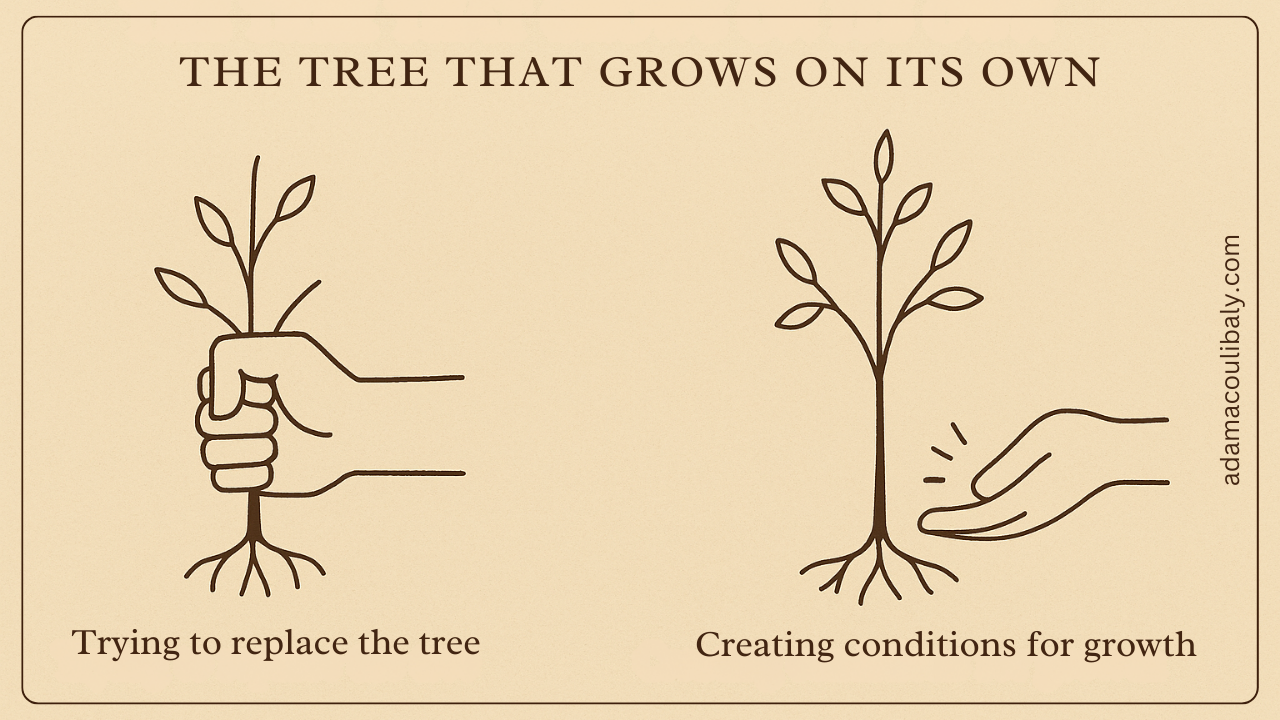
Illustrated by me (A. Coulibaly) with canva.com
People often ask me where my passion for localisation and decolonisation stems from. I always struggle to find the right words to answer. When a conviction takes root in the heart long before it reaches the mind, it becomes difficult to explain in logical terms. The roots run too deep. Every time I am asked this question, I realise that I must return to the place where that seed was planted.
A journey into the forest and the wisdom of Foster the Wise.
I joined Plan International in Guinea shortly after graduating with a degree in Water and Environmental Engineering from the International Institute for Water and Environmental Engineering (2iE) in Ouagadougou, Burkina Faso (formerly the Inter-State School of Rural Infrastructure Engineers, or EIER). What I expected to be a technical role quickly evolved into something more profound: a lesson in power, Partnership, and the quiet leadership of communities.
The Country Director, James Frederick Foster — known to colleagues as Fritz and to the local communities as Falo Foster (Foster the Wise)— had made an unusual choice. Rather than locating the country office in the capital city of Conakry, he established it in Gueckedou, in the forest region on the border of two countries embroiled in civil war: Sierra Leone and Liberia. My first journey from the capital took me from sunrise to nightfall. The city faded into the forest, the roads narrowed, the number of checkpoints increased, and life took on a slower, more resilient rhythm. I did not yet realise that those eight years would shape my subsequent beliefs about development and justice.
At the heart of that transformation was Falo Foster. His leadership was quiet yet decisive. He listened deeply, trusted his instincts and believed in communities long before the sector adopted the language of localisation. He also believed in young professionals like me, entrusting us with responsibilities that forced us to grow, reflect and adapt.
One day, I asked what I thought was a simple question about the true purpose of an organisation like Plan International. Instead of quoting a mission statement, he offered a metaphor that has stayed with me ever since. He told me to imagine a tree. A living tree that finds its own water and nutrients, and grows in its own direction. Our role, he said, is to create the conditions that allow the tree to flourish. We must never substitute the tree, overshadow it or stand in the way of its natural strength.
Genuine partnership requires the humility to step back and allow others to flourish.
When a metaphor becomes a way of working
What followed was the most practical demonstration of that philosophy that I had ever seen. The tree was more than just an image. It became a structure.
Every year, at least 80% of the country budget was transferred directly to communities. These allocations were published transparently in a small newspaper called Partenariat (Partnership) and displayed in markets, schools, health centres and youth spaces. I can still picture villagers gathering around noticeboards, reading their allocations and reclaiming a sense of visibility that had often been denied to them.
Communities would meet to set their priorities, often under mango trees. Their 20% contribution, usually in the form of labour or materials, fostered a strong sense of ownership. Women carried sand in woven baskets from the riverbank. Men crushed stones for the foundations. Young people cleared project sites. These were not activities driven by outsiders. They were collective decisions shaped by collective responsibility.
Management committees were elected to ensure gender parity, giving women a new voice in decisions that shaped their villages. These committees supervised progress, selected suppliers, and ensured accountability.
Each year, communities and staff held participatory evaluations where people openly discussed successes, failures and lessons learned. These sessions were not just symbolic rituals. They informed every new cycle.
When communities excelled, they were honoured through the partnership caravan, a travelling celebration that recognised communities rather than institutions. The caravan was joyful, honest, and based on the idea that progress belongs to those who make it happen.
Meanwhile, Plan deliberately remained small. Staff were encouraged to establish independent local organisations that could serve communities in the long term. This is how three Guinean institutions emerged:
AACG (Association des Animateurs Communautaires de Guinée), which specialises in facilitation and social mobilisation;
WEST Ingénierie, a consulting and engineering firm providing design, supervision, and quality assurance; and
TransCons is an auditing and control structure that strengthens transparency and accountability.
These institutions did not fill a gap. They became part of the ecosystem. Their emergence affirmed a simple truth: strong roots grow from within.
A playbook shaped by the forest region
Today, with the sector speaking with urgency about localisation and decolonisation, I am often reminded of those years in the forest region. Many of the principles that we now consider innovative were already being practised quietly and confidently more than three decades ago. If I were to summarise the lessons that shaped me, they would take the form of five truths.
Firstly, resources must be close to the people who make the decisions. When communities saw their allocations displayed openly and controlled most of the budget, priorities aligned with real needs and ownership became natural.
Secondly, organisations should stay small so that others can grow. Plan's intentional smallness created space for AACG, WEST Engineering, and TransCons to flourish. When international actors step back, local ecosystems expand.
Thirdly, strong institutions grow from within, not from outside. The most lasting transformation did not come from projects, but from the emergence of capable local institutions that were rooted in community trust.
Fourthly, transparency must be shared, not demanded. The Partnership newspaper levelled the playing field by making budgets, evaluations and results visible to all. Trust grew because information flowed towards communities.
Lastly, recognition should belong to communities, not organisations. The partnership caravan celebrated people, not Plan International. It reinforced the truth that progress belongs to those who create it.
Returning to the roots of the question
So, when asked where my passion for localisation and decolonisation stems from, I am reminded of the forest region of Guinea, a simple lesson about a tree, and a mentor called Falo Foster. I remember the realisation that:
Development is not something we deliver. Rather, it is something we make space for. This process requires humility, patience, and the courage to allow communities to grow organically.
The tree always knew how to grow. I learned to stop standing in its light.
#Localisation #Decolonisation #CommunityPower #LeadershipReflections #PositiveMinds
