

When localisation gives the key, but keeps the string
PositiveMinds | Positive Stories | Edition 076
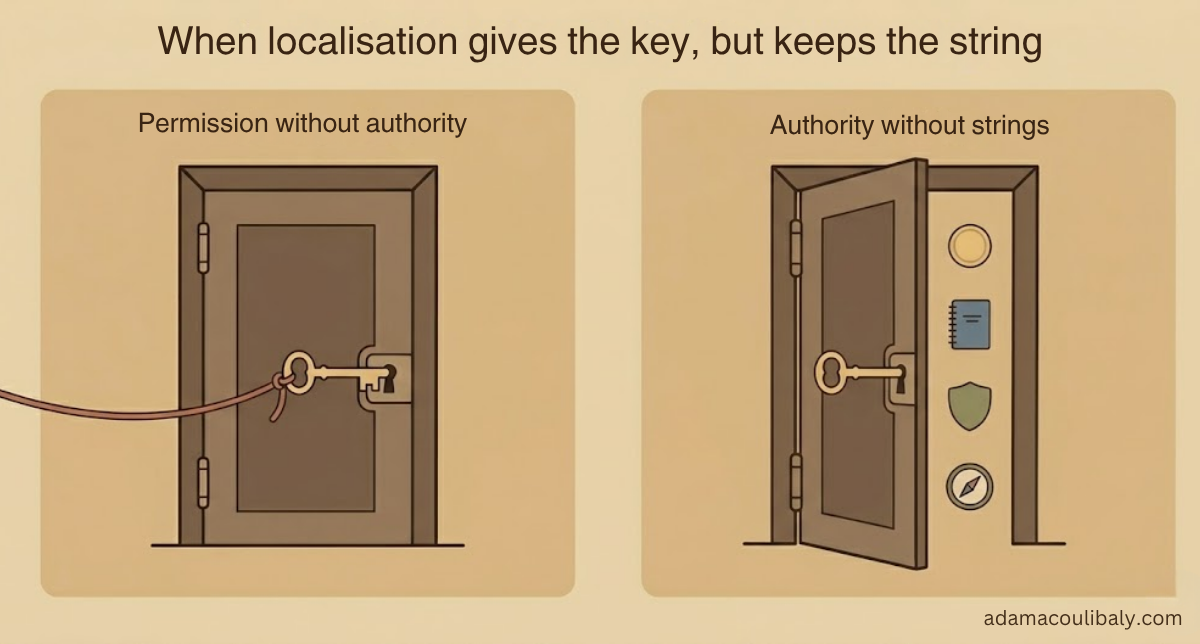
Illustrated by me (A. Coulibaly) with canva.com and Gemini by Google
Three years ago, when I began my role as Oxfam’s Global Programs Director, I spent my first months speaking with peers across the INGO sector. I wanted to understand how others were thinking about localisation, decolonisation and the future role of international organisations.
One conversation stayed with me. It was with a peer from another organisation. The exchange was honest and thoughtful. We were not disagreeing about localisation, at least not at first.
Then they said:
“I support localisation, as long as it helps us deliver faster, cheaper, and with less risk to us.”
It was not said with cynicism. It sounded almost like common sense.
And I understood it.
International organisations are under pressure. Funding is tighter. Donors want more evidence, more speed and more control. Boards want assurance. Finance teams want clean cost recovery. Safeguarding teams want no avoidable harm. Programme teams want quality. Country teams want space to act without carrying risks they cannot control.
Under that pressure, the sentence makes sense. If localisation helps us deliver faster, cheaper and with less risk, why would we not support it?
But the longer I sat with that sentence, the more it troubled me. It asks local actors to prove their value by making the current model work better for international organisations. It does not ask whether the model itself needs to change. It keeps the centre in place, then asks who can help the centre deliver.
What if localisation is not meant to make international organisations more efficient? What if it is meant to make power more honest?
Risk rarely arrives as a dramatic moment. It often arrives as habit. A partner agreement is tightened. A budget line is held back until capacity is proven. A decision is escalated because the organisation cannot afford a mistake on paper.
None of this is unreasonable. Compliance matters. Safeguarding matters. Accountability matters. Weak controls can cause harm. The instinct to hold on deserves some sympathy.
But every grip has a threshold. At first, holding on protects the work. After a while, it begins to weaken it.
Many organisations ask local partners to be closer to communities, quicker in emergencies and more agile when plans change. Yet the things that make leadership real often remain elsewhere: flexible funding, decision authority, the right to define risk, and a voice in governance.
Local organisations are trusted with proximity, but not always with power. They are trusted to reach communities, but not always to shape priorities. They are trusted to carry risk, but not always to define it.
Responsibility can move without power moving. That is where localisation becomes fragile.
For a time, this can still look like progress. Local partners appear in proposals. Localisation language fills strategies. More people are invited into rooms where decisions once happened without them.
The bridge is visible.
But the test is not whether the bridge exists. It is what crosses it.
Does money cross it? Does authority cross it? Does trust cross it? Does the right to challenge cross it? Or do only tasks and expectations move, while power stays where it has always been?
This is not only a sector question. It is also a question we continue to face inside Oxfam.
There are things we are trying to do differently. Oxfam is a signatory to the Pledge for Change, with commitments on equitable partnerships, authentic storytelling and influencing wider change. We have also been working on the Collaborative and Adaptive Partnering Approach, or CAPAS, which seeks to shift partnership assessment away from one-way scrutiny towards a more open conversation about purpose, power, risk, behaviour and co-creation. Our Local Humanitarian Leadership work has also, in different contexts, sought to start from the leadership of local actors rather than from the convenience of international systems.
But these are not trophies. They are not proof that we have arrived. They are signs of a learning process.
CAPAS is a good example of this learning in practice. It tries to make partnership conversations more mutual, more adaptive and more attentive to power. At the same time, it has to work within real donor rules, legal responsibilities, compliance requirements and financial risks. That is why it matters as part of a wider shift, not as a single answer.
The Pledge for Change can be a useful mirror, but only if partners and local actors can tell us what they actually see in that mirror. Local Humanitarian Leadership can sound right in principle, but it only matters if local actors can shape decisions before plans become fixed.
This is where Oxfam’s learning from the Philippines is helpful. The lesson is not simply that local actors are physically closer to the crisis. It is that they often see what standard response templates miss. They notice risk through culture, gender, stigma, fear, relationships and trust.
During the Marawi crisis, AMDF, a women’s rights organisation based in Marawi, understood risks that could have been missed from a distance. Tents were not only a shelter option. In that context, AMDF warned that they were culturally inappropriate and could increase the risk of gender-based violence. The response needed more than distribution. It needed listening spaces, trust and a way for displaced families to speak about needs that were not visible in a rapid assessment.
The Family Conversations led by AMDF did more than gather information. They helped shape a People’s Agenda for recovery and rehabilitation. They surfaced protection concerns, women’s priorities and community plans that might otherwise have remained hidden.
The same pattern appeared during the COVID-19 lockdowns in Metro Manila’s BASECO Compound. From a distance, digital cash transfers looked efficient. On the ground, KABALIKAT saw a different reality. Local stores were not ready for digital payments. Families in quarantine needed to stay home. Fear and stigma were shaping behaviour. KABALIKAT and UPA redesigned the initial response around a community grocery credit line, with local volunteers delivering food and support to isolated households.
These examples matter because they show something simple. Local organisations often hold assets that cannot be flown in during a crisis: trust, memory, relationships, local judgement and the ability to read what is changing before it appears in a formal report.
This does not mean local organisations are always better, safer or more accountable. That would be too neat and not true. Local organisations also face political pressure, resource limits, personal risk and local power dynamics.
But it does mean the risk question must change.
For years, the question has often been: what might go wrong if we localise?
That question still matters. But it is no longer enough.
We must also ask: what is already going wrong because we do not?
An international organisation can keep the grant, the brand, the compliance system and the donor relationship, while slowly losing the access and trust needed to do the work well. It can protect control but lose relevance. It can manage risk on paper and miss the risks growing in practice.
The greater risk may not be moving power too quickly. It may be holding power too long.
This is why localisation cannot stop at better partnership practice. Better practice matters. It can reduce harm and improve relationships. But it is not the same as power moving.
The test is more direct. Can local organisations influence the work before it is designed? Can they question an international partner without fear of losing funding? Can they receive resources that strengthen their own institution, rather than just deliver someone else’s project? Are they treated as organisations that interpret context, not only as sources of data from it?
These are not abstract questions. They decide whether an organisation is changing or only sounding different.
They also raise a harder question about the future role of international organisations.
The answer is not that they should disappear. That is too simple. There are still useful roles to play: raising funds, supporting coordination, managing complex donor requirements, connecting local action to global advocacy, providing technical support, and helping carry risks that should not fall on local organisations alone.
But those roles have to be earned. They cannot rest on size, brand or habit.
The question is simple: are we using our power to strengthen local agency, or to protect our place in the chain?
The test of localisation is not the language we use when things are easy. It is what changes when money, risk and visibility are at stake.
Localisation is easy to support as a principle. It is harder when a donor wants speed, when a budget shrinks, when compliance concerns rise, when visibility is negotiated, or when a local organisation challenges the behaviour of its international partner.
Those moments reveal more than strategy papers do.
If power moves only when conditions are comfortable, then it has not really moved. It has been lent.
And power lent can always be taken back.
That is why the sentence from my peer still matters to me.
“I support localisation, as long as it helps us deliver faster, cheaper, and with less risk to us.”
It sounds reasonable. But it leaves the old measure untouched.
Faster for whom? Cheaper for whom? Less risk for whom?
If localisation only counts when it makes the international organisation more efficient, then the centre remains the judge. Local actors are still being asked to prove their value against someone else’s comfort, someone else’s timelines, someone else’s risk appetite.
That is not power shifting. It is the old model asking for better terms.
Perhaps the risk is not that localisation asks us to release control. The risk is that we keep offering the key while holding the string.
References
Vera, C. A., and Brusola-Vera, M. L. (2021). Local Humanitarian Leadership: The View from Local Actors. Oxfam Research Report, May 2021.
Humanitarian Practice Network. Beyond definitional ambiguity: locally led action as baseline, localisation as reform. February 2026.
Inter-Agency Standing Committee. Humanitarian Reset: Frequently Asked Questions. January 2026.
ODI. As local as possible, as international as necessary: understanding capacity and complementarity in humanitarian action. November 2018.
Start Network. Localisation Works: Locally-led humanitarian action in the context of the Reset. February 2026.
