

The Bowl That Kept Me at My School Desk
What a scoop of powdered milk taught me about aid, before I had a word for it
PositiveMinds | Positive Stories | Edition 077
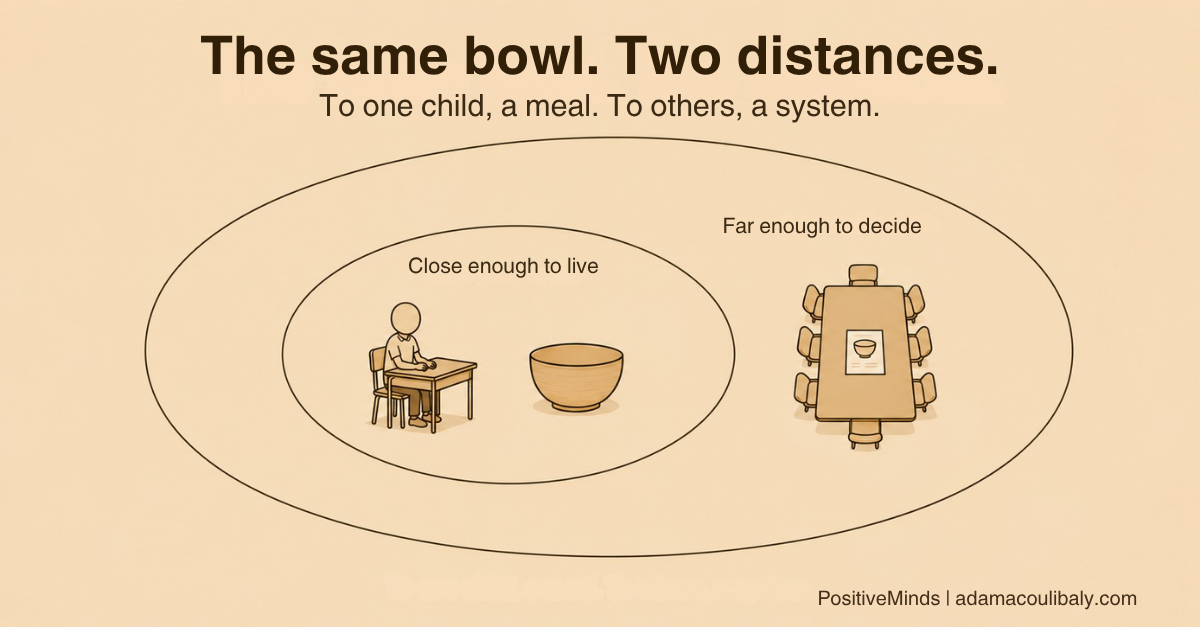
Illustrated by me (A. Coulibaly) with canva.com
I was born in southern Mali in the 1970s, during the Sahel drought of 1968–74. It killed an estimated 100,000 people across the region and left hundreds of thousands depending on food aid to survive. I did not know any of that as a child. I only knew that some years the millet came in, and some years it did not.
Food crises were not a single event for us. They were a rhythm. A bad rain, then a thin harvest, then a hard season, then, if we were fortunate, recovery. Then the cycle again. The sky set the rhythm, but the sky was never the whole story. Communities like mine had little cushion against a bad year, and how much cushion a community holds is not decided by the weather. In a household already stretched thin by that rhythm, birth order was never neutral. I was the first child of a polygamous family, and that came with a role attached, not just a place in the line. I was watched to see what example I would set. I was expected, before long, to help carry the household. When the harvest was thin, a firstborn child was among the first hands a family would call on, not the last.
A firstborn child is not asked if they have time to help. They are simply expected to have made it.
That is the direction my life could easily have taken. Fetching water. Looking after younger siblings. Working land that needed hands more than it needed a child at a school desk. What kept me at that desk, more days than not, was a bowl.
At school, once a day, we were given a ration through a World Food Programme feeding programme. Almost none of it came from our own fields or even our own country. Bowls like mine were filled with what international food aid shipped in those years: a porridge of sorghum, maize or wheat, a protein supplement, and oil for calories. What I remember is the powdered milk, mixed with water, and the dried, salted fish, broken into small pieces over the grain. I did not know, then, what WFP stood for. I knew the smell of the fish and the particular chalky taste of the milk, and I knew that bowl was often the most certain meal of my day.
Except on the days there was no school. We hated Sundays. We hated public holidays. No school meant no rations, so a day off was not a rest. It was a gap. I did not have the language then to call that irony. I only had the hunger of a Monday morning that felt, strangely, like relief.
We did not long for the day off. We longed for it to end.
That gap taught me something before I had a word for it. Some days, a system outside my family decided whether I ate. Not shameful. Not undignified. Just a plain, physical fact, and one that gave my family a reason to let me carry my share of the household from a desk, rather than from a field.
I say this because I know how the debate about aid usually goes. Someone points to what it has fed, vaccinated, taught, and cured. Someone else points to the dependency it can create, the power it concentrates in the giver, and the conditions that can arise without anyone asking to sign them. Both are right, and both are talking about the same bowl from different distances. From where I sat, seven or eight years old, waiting for a Sunday to end, the debate about power and dependency was not wrong. It simply was not the question in front of me. The question before me was whether I would eat that day or wait until Monday.
A system can need deep reform and still keep a child fed. Both things can be true at once.
Let me be clear about what follows from that, because in a season of aid cuts, it is easily twisted. The answer to an imperfect bowl is not an empty one. Taking the ration away reforms nothing. It only returns the hunger. When I question how aid works, I am not arguing for less of it. I am arguing about who decides.
I carry that bowl with me now, in a very different seat, in conversations about funding models, partnership terms and the language we use for the work we do. It keeps me honest about two things at once.
First, that reform is not betrayal. Questioning how aid is designed, who decides its terms, and where the power sits, is not an insult to the people it once fed. It is a way of asking whether the next firstborn child gets to stay at their desk without carrying the costs my generation carried alongside that bowl: the waiting, the conditions, the sense that help always arrived from somewhere else, decided by someone else. Even the food in the bowl had made that journey.
Second, that reform without memory becomes its own kind of distance. It is easy, from a table far from any child, to speak of aid only as a system to be fixed or replaced. It is harder and more honest to remember it has also been someone's bowl. Somewhere, right now, it still is. Some child, somewhere, is dreading Sunday for the same reason I did.
That is the real distance in this story. Not the miles the food travelled to reach my bowl, but the distance between a table where a decision is made and a child who eats, or does not, because of it.
Some of that distance has begun to close. School meals are increasingly bought from farmers near the schools they serve, so that the bowl feeds a community twice. That is the right direction. The question is why, fifty years after my bowl, it is still the direction and not yet the norm.
We do not have to choose between gratitude and criticism. I hold both. Grateful for a scoop of milk that bought me time at a desk. Clear that the next child deserves a bowl that is filled more fairly, and decided closer to home.
The bowl was never the whole answer. But it was enough of one, for one child, more days than not. That has to count for something, even as we build something that no longer asks a child to dread the day off.
#Decolonisation #Aid #Localisation #GlobalDevelopment #Leadership
References
The Sahel drought, 1968–74: widespread famine and displacement across Mauritania, Mali, Chad, Niger, and Burkina Faso, with an estimated 100,000 deaths and hundreds of thousands of people dependent on food aid.
