

Influencing When Civic Space Closes
Protecting people without closing the road too early.
PositiveMinds | Positive Stories | Edition 079
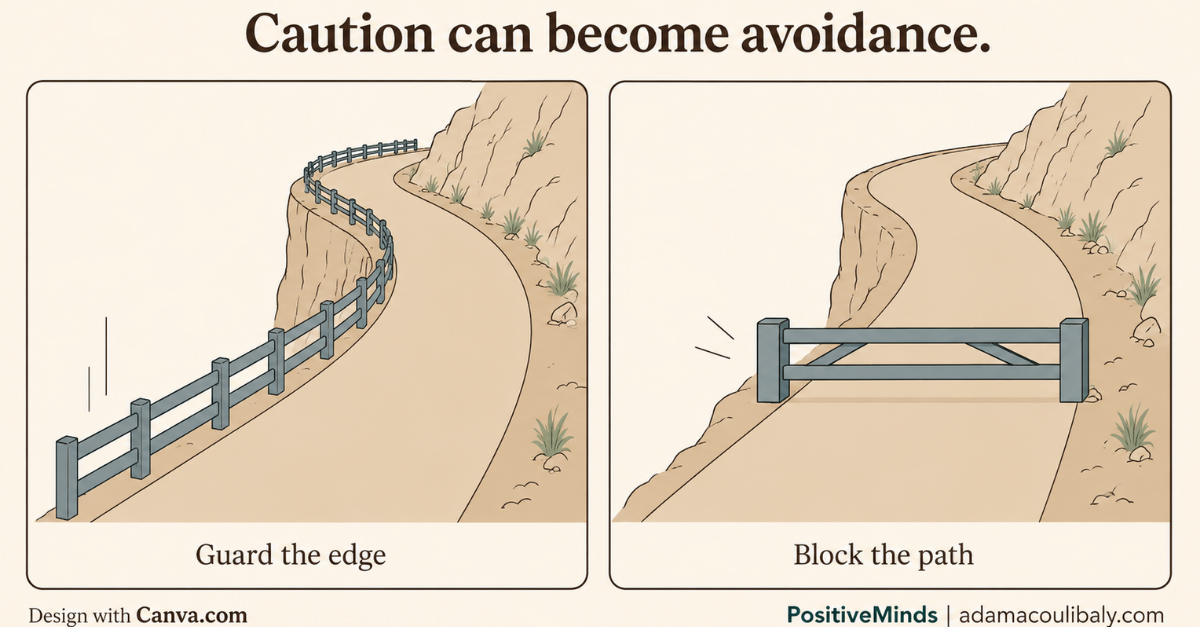
On a dangerous cliff road, a guardrail and a roadblock are both responses to risk.
A guardrail accepts that the road is dangerous and gives people some protection as they travel. A roadblock makes a different judgement: the road should not be used.
From a distance, both can look like safety.
Something similar can happen as civic space closes. Governments restrict protest, tighten rules around civil society organisations, monitor activists or punish people for speaking publicly. Organisations respond by becoming more careful, as they should. Yet caution can gradually narrow the range of actions people are willing to consider, sometimes before those actions have actually been taken away.
A guardrail protects movement. A roadblock removes it.
The danger behind this image is real. The CIVICUS Monitor’s People Power Under Attack 2025 reports that only 7% of the world’s population lives in countries where civic space is rated open or narrowed. It also recorded restrictive laws or regulations affecting civic freedoms in at least 66 countries during 2025.
Pressure also reaches into digital life. Freedom House’s Freedom on the Net 2025 found that internet freedom declined for the fifteenth consecutive year. People were arrested or imprisoned for online expression in at least 57 of the 72 countries it assessed.
Human Rights Watch’s World Report 2025 describes a wider pattern of governments trying to silence or weaken independent civil society. Its reporting from individual countries shows what that can mean in practice: intrusive controls, surveillance, harassment and detention, sometimes leaving activists censoring themselves or withdrawing from public work.
None of this makes caution misplaced. A statement, meeting, demonstration or public report can carry consequences for the people involved and sometimes for their families. Organisations have a responsibility to think seriously about those consequences.
The harder question begins after we acknowledge that risk: how do we protect people while preserving as much space for action as the context allows?
First, influencing can change shape
Public influencing remains central to defending civic space.
Campaigns can expose abuse that would otherwise remain hidden. Public research can put evidence into debate. Protest can make visible what authorities or institutions would rather ignore. Media work can bring an issue far beyond the people already affected by it. In many situations, influence comes from visibility.
The CIVICUS State of Civil Society Report 2025 documents civil society using public mobilisation, litigation, advocacy and international solidarity to challenge restrictions and press for change. These forms of action still matter, even as the space around them becomes harder.
But the same approach will not carry the same risk everywhere.
Where direct public advocacy becomes dangerous, some groups work through coalitions or institutions that still have access to decision-makers. Others combine work inside the country with international advocacy. Legal action may become more important. Researchers, professional bodies, religious leaders or regional organisations may sometimes be able to carry an issue into rooms that have become difficult for others to enter.
ICNL’s work on multilateral engagement and civic space describes this kind of combination. It treats engagement through regional and global institutions as a complement to domestic advocacy, while also warning that international visibility can expose people to retaliation and should be planned with that risk in mind.
So the choice is rarely between being public and being quiet.
A public campaign may continue while some conversations happen privately. A coalition may speak collectively when one organisation would be exposed alone. An international partner may amplify an issue outside the country while those closest to it decide how visible they want to be. In another setting, local organisations may lead publicly because they have the credibility and relationships that an international actor lacks.
The form changes because the context changes.
Influence does not lose its value when its visibility changes.
That is different from treating quiet influence as inherently safer or wiser. It can preserve relationships and create openings. It can also become a comfortable reason to avoid a difficult public position.
The same is true of visibility. Going public can create pressure and protection. It can also increase exposure.
No form of influence carries the right answer on its own.
And once the form changes, another question follows quite naturally: who is now carrying the risk?
Second, watch where the risk goes
This matters especially as international organisations and donors seek to move more power and decision-making towards local actors.
That shift responds to a longstanding imbalance. Yet the conditions in which local organisations work cannot be separated from it.
ICNL’s analysis of localisation and civic space points to laws and practices that restrict civil society organisations from registering, operating or receiving foreign funding. Some rules also stigmatise organisations because of their links with international donors or partners.
This means that moving responsibility locally does not automatically move protection with it.
An international organisation may have diplomatic contacts, lawyers, flexible funds or the option of moving a colleague out of a country. Some local organisations also have strong networks and considerable protection, while some international organisations have very little. The distinction is not neatly local versus international.
What matters is the protection surrounding the particular person who becomes exposed.
A senior director may have more institutional cover than the colleague whose face appears in a campaign video. A well-established national organisation may be better connected than a small international group. A researcher working behind the scenes may attract less attention than the activist whose name appears beneath a public statement.
Risk is distributed unevenly.
When responsibility moves, we should watch where the risk goes.
That has practical consequences. One organisation may need legal support. Another may need stronger digital security or money that can be moved quickly when conditions change. People may need to reconsider travel, communications or the visibility of particular colleagues.
ICNL’s guidance on multilateral advocacy makes the same point in a specific setting: organisations considering international engagement are encouraged to assess the risk of reprisals beforehand and make plans for digital protection and other possible consequences.
Those choices cannot all be made in advance.
A situation can change overnight. A relationship that offered some protection can weaken. Someone previously seen as a safe intermediary may come under pressure themselves.
This is where risk becomes a question of judgement.
Third, keep judgement close to the context
Policies matter because they give people something firm to stand on.
They can define responsibilities, set minimum standards and make clear what support should be available when pressure comes. They can also prevent every difficult situation from being treated as if nobody has faced anything similar before.
But policy has limits.
It cannot know that the tone of a meeting changed yesterday. It cannot know that a person who was safe to approach last month is now being watched. It cannot tell whether issuing a public statement this afternoon will create useful pressure or expose someone whose circumstances changed this morning.
A policy can set the guardrails, while judgement still has to read the room.
And judgement is usually better when more than one person helps make sense of what is happening.
My mother used to say:
“One person brings one thought. Two people bring two. Many people bring many.”
I have returned to that line often.
Someone else may recognise a pattern we have missed. A person close to the issue may see a risk invisible from outside. Someone who has lived through a similar restriction may know what followed the first warning signs. An ally elsewhere may see an opening that is hard to see under pressure.
This is also part of why coalitions matter. ICNL’s work on multilateral engagement notes that coalitions can widen access to institutions and strengthen civil society’s collective voice, while CIVICUS continues to document movements and organisations working together across borders when national space becomes harder to use.
Sharing experience does not make the road safe. It gives people more information about the road they are actually on.
There will still be moments when stopping is the responsible choice. Some forms of exposure cannot be justified. Sometimes authorities really have closed an avenue of action, and pretending otherwise can put someone else in danger.
But another possibility is worth watching.
Sustained pressure can cause organisations and individuals to withdraw before any formal prohibition arrives. Human Rights Watch has documented cases where harassment, detention and intrusive controls have pushed activists towards self-censorship or out of public work altogether.
That is one of the quieter ways civic space can shrink. Authorities impose pressure, and organisations begin adjusting to what they fear might come next. Each individual decision may be reasonable. Taken together over time, however, they can leave much less space than the law itself has removed.
Which brings me back to the cliff road.
A guardrail does not deny the danger. Its purpose is to make movement possible despite it. A roadblock also has its place when the road has genuinely become too dangerous to use.
Between the two lies judgement. Some moments call for public campaigns; others call for quiet engagement. Often they will reinforce each other. Sometimes another route must be found. And sometimes the responsible decision is to stop.
The danger deserves to be taken seriously. So does the possibility that, in trying to protect people from it, we may close a road before we have fully understood whether another way through remains open.
