

Ten years after the Grand Bargain, responsibility is moving faster than power.
PositiveMinds | Positive Stories | Edition 078
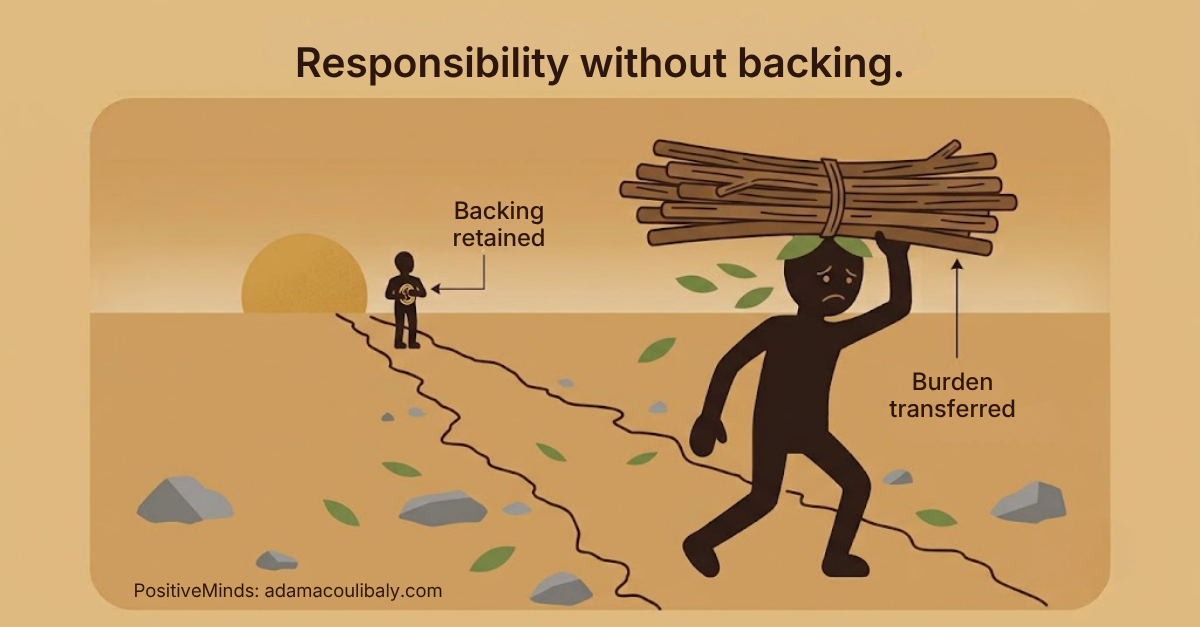
Illustrated by me (A. Coulibaly) with canva.com
As children, my friends and I used to walk into the bush to gather firewood. We learned the craft early. No one set a bundle on a bare head. First came the cloth, a strip of fabric coiled into a ring on the crown, so the neck could bear the weight. I remember a day I had not brought a cloth and improvised with tree leaves. They looked the part for about a hundred steps. Then they slipped, crumbled and bit into my scalp, and I spent the rest of the road negotiating with my own load. With the cloth, the walk was different. Each of us chose our own path and pace. The one who carries is the only one who knows where the weight presses.
I think about that cloth when I hear the word localisation.
In most crises, local actors are first on the scene and last to leave. They hold the trust, the languages, the histories and the relationships that decide whether a response works. They are not waiting to be empowered. Commitment they have. What they are short of is backing: the money, the authority and the protection that large international organisations still hold. That backing is the cloth.
And the question lands on shrinking ground. The Global Humanitarian Assistance Report 2026 finds the humanitarian system 30 per cent smaller than in 2023. Funding has fallen back to the levels of 2017, while the number of people in need has more than doubled since then.
Under that pressure, the aid system has become skilled at moving the load. It has been slower to move the cloth. Responsibility too often travels alone. Local organisations are asked to deliver more, reach further, absorb more risk and remain when others leave. Meanwhile, the money arrives slowly and in short supply, the decisions stay upward, and the protection stays uneven. When funding grows scarce, the cloth wears thin. Sometimes it disappears altogether.
That is not localisation. It is delegation under pressure.
Three things must move together. The evidence tells the same story about each.
Money. This year marks a decade since donors and agencies signed the Grand Bargain and committed to channel at least 25 per cent of humanitarian funding to local and national actors as directly as possible. Ten years on, the same 2026 report finds that in 2025 only 8.7 per cent of reported humanitarian funding reached them directly and indirectly, down from 9.5 per cent the year before. Direct funding is thinner still: Development Initiatives found it was 0.6 per cent in 2023.
Worse, the direction of travel has reversed. When overall funding fell in 2025, funding to local and national actors fell faster, down 27 per cent, outstripping the wider decline.
And look at the shape of what remains. Funding is consolidating: larger grants, longer timeframes, multi-country scope, delivered through consortia. Each of these shifts favours large, established organisations, the ones with the balance sheets and compliance capacity to hold big, complex contracts. No one announces any of this as a decision about localisation. But every shift moves in the same direction, at the very moment the sector committed, on paper, to the opposite.
Scarcity does not only shrink the money. It quietly reorders who is allowed to hold it.
As for what does reach local organisations, it is too often leaves rather than cloth: short subgrants we pass down after taking overheads and compliance costs elsewhere, money that pays for activities but rarely for governance, reserves, staff care or safeguarding systems. We then judge those organisations against standards we never provided the resource to meet.
Authority. This one has no number. What truly counts is rarely counted. Who sets the budget ceiling? Who defines risk? Who decides when a programme closes, and a community is left? A local organisation can know which road is blocked, which elder can open access, which rumour could start a fire, and which family has been missed, and still have no say in the design. Being consulted once the choices are made is courtesy, not authority. Many local actors are close to the risk and far from the decision.
Protection. When responsibility moves down, exposure moves with it. Local responders face state pressure, community anger, legal restrictions, online attacks and sometimes violence, often with no security budget, no legal cover and no one to call. Women-led organisations carry the sharpest edge of it. Beyond the Breaking Point, a UN Women report published this month drawing on 855 women's organisations in 52 crisis-affected countries, found that two in five expect to shut down within a year.
Little of this is designed, and even less is malicious. It is what scarcity does to a system that has not changed its habits: when budgets tighten, each actor protects what it can control, and the pressure rolls downhill. The temptation, in a contraction, is to pass the load faster and call it reform. A shrinking system that transfers burden without transferring backing is not shifting power; it is shedding weight.
It would be easy to draw the line in the wrong place. It does not separate people; most staff of international organisations are themselves national and local. It separates institutions: where the money sits, where the rules are written, where the risk is decided. And that is where the answer starts.
Most humanitarian funding will continue to flow through international intermediaries for some time yet. That makes the obligations of intermediaries the strongest lever we have. When large organisations receive funding on behalf of others, the commitments they have signed, the Grand Bargain, the Charter for Change and the Pledge for Change, must travel down the chain with the money: fair overheads that reach partners, risk genuinely shared rather than moved downwards, and decisions made with partners rather than for them. None of these is technical adjustments. They are choices, made where leadership and governance sit: in budget rounds, in decisions about risk, in boardrooms. Due diligence should open doors, not only close them. A commitment that loosens whenever budgets tighten was never a commitment, only decoration.
I write this as someone inside one of the organisations that signed the Pledge for Change, and I will not pretend we are exempt. In 2024, the Pledge's signatories asked their partners how we are doing through a southern-led survey of 342 local and national organisations in 61 countries. The answer was a mirror, not a compliment. Partners see progress where decisions are shared: 82 per cent said they help define project scope and success measures. They see much less movement where the cloth matters most. Half report being underfunded for the work they carry. Nearly half say efforts to recognise the risks they face remain inadequate. Holding ourselves to what we signed is a long and bumpy journey, and we are still on it. But organisations that ask the sector for accountability must first accept it within their own organisations.
So, before we call something localisation, a simple test, one worth carrying into the next budget round or board discussion. Who holds the budget? Who can change the plan? Who carries the risk? And who is protected when things go wrong? If the answers are not moving closer to local actors, then the load has moved, but the cloth has not.
The children I walked with understood something the aid system is still learning. You do not honour a carrier by admiring their strength from a distance. You honour them by coiling the cloth and letting them choose the road.
Localisation is not measured by who carries the load. It is measured by what travels with it.
If you lead or govern in this sector, I would welcome your answers to the four questions, especially the uncomfortable ones.
References
ALNAP/ODI Global, Global Humanitarian Assistance Report 2026 — funding to local and national actors in 2025; size of the humanitarian system and people in need.
Development Initiatives, Falling Short? Humanitarian Funding and Reform (2024) — direct funding to local and national actors from Grand Bargain signatories in 2023.
UN Women, Beyond the Breaking Point (July 2026) — survey of 855 women-led and women's rights organisations in 52 crisis-affected countries.
WACSI / Pledge for Change, 2024 Partners Survey: Key Findings and Recommendations (April 2025) — southern-led survey of 342 local and national partner organisations in 61 countries.
Inter-Agency Standing Committee, the Grand Bargain; Charter for Change; Pledge for Change.
