

The Paradox of Embedded Agency
Can we change institutions while working within the systems that have shaped them?
PositiveMinds | Positive Stories | Edition 080
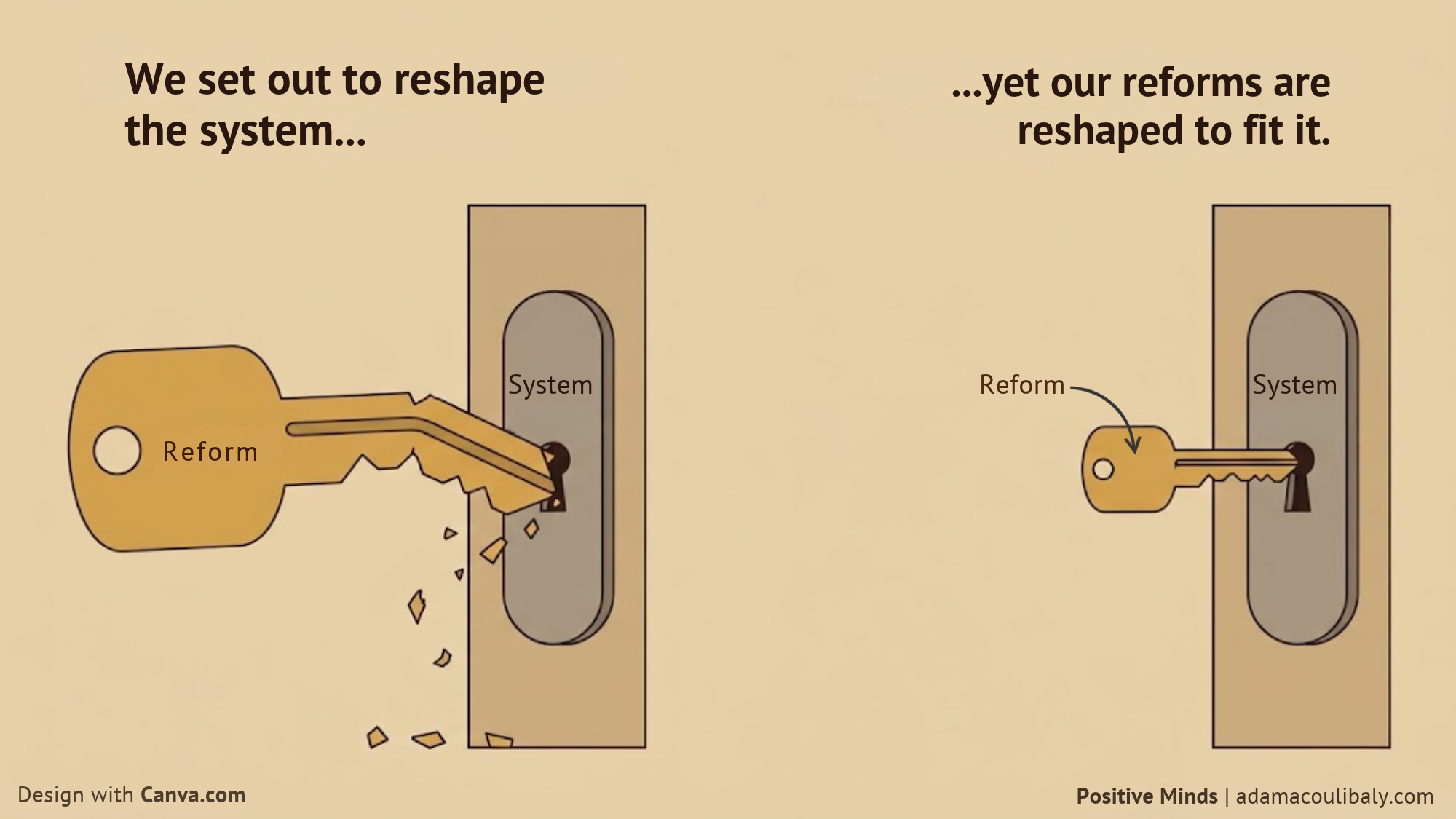
I have taken part in enough discussions about the future of international aid to recognise genuine commitment when I hear it. People want local and national organisations to have more resources, greater influence and the freedom to shape their own futures. Yet I often come away with a troubling thought. We seem to agree on the changes we want, while the institutions expected to make them happen continue to work much as before.
Through my role at Oxfam, I have the privilege of joining these conversations regularly. Localisation and decolonisation have become central to how I understand my work as a development practitioner. I believe deeply in both. They are right, long overdue, and essential to the future of our sector.
We have certainly not lacked initiatives. The Charter for Change pressed international NGOs to improve partnerships and increase funding to national organisations. The Grand Bargain set a collective target for at least 25 per cent of humanitarian funding to reach local and national actors as directly as possible. Start Network has been developing locally led humanitarian networks with greater control over resources and responses. The RINGO Project has challenged the established role of international NGOs, while the Pledge for Change now explicitly recognises internal transformation as part of shifting power.
These efforts have helped shift the conversation and, in some places, how organisations work. They also reflect years of pressure from local actors who have persistently questioned the inequalities of the aid system.
Still, the results remain disappointing. A May 2026 review by ODI Global found that only 9.5 per cent of international humanitarian funding reached local and national actors in 2024, directly or indirectly. Almost a decade after the Grand Bargain, this remains far below the agreed ambition.
I have often been frustrated by this record. The criticism that international organisations fail to practise what they preach is sometimes deserved. But it does not fully explain what I have encountered over the years.
Many of the leaders and colleagues I work with genuinely want change. They question familiar practices, support different ways of working and understand why the current arrangements cannot continue indefinitely. Their commitment is real.
So why does the distance between what we believe and what our organisations do remain so wide?
I recently found a useful way of thinking about this in a concept known as the paradox of embedded agency.
It describes the difficulty people face when trying to change institutions that have shaped their own thinking and behaviour. Over time, we learn what is expected of us, which choices are considered responsible and how to succeed within established arrangements. Those habits do not disappear simply because we come to believe that something should change.
Consider how many established institutions operate. Governing boards are expected to safeguard continuity and financial health. Leaders carry responsibility for commitments made over many years. Finance, audit and compliance systems provide assurance that resources are properly managed and obligations fulfilled.
There are sound reasons for these responsibilities. Institutions need stability, and many safeguards exist because past failures caused genuine harm. Yet these arrangements also shape what people regard as acceptable or possible. A proposal that fits existing rules is easier to support than one that calls the rules themselves into question.
People can believe in change while working within systems that continue to reward continuity.
I see the consequences when unfamiliar approaches are treated as exceptions. An organisation may support a new way of working, but only through a special arrangement, additional conditions or a limited pilot. Colleagues invest considerable effort in making it work, sometimes with encouraging results.
Then the pilot ends. The next initiative may face the same requirements, and the people proposing it must make their case all over again.
There is nothing wrong with testing ideas. Pilots help us learn and avoid mistakes. Their lasting value, however, depends on what the institution changes as a result. A successful initiative should eventually influence the ordinary rules, expectations and ways of working.
Otherwise, we may become better at managing exceptions while leaving the arrangements that made them necessary largely untouched.
This is where I worry about our preference for gradual change.
Small improvements can bring immediate benefits. They can also reassure us that progress is being made, especially when deeper changes seem difficult or unsettling. But years of modest adjustments have a cost. They consume time, resources and attention, while local organisations continue to work within a system whose basic assumptions remain familiar.
A reform that feels manageable today can leave tomorrow's problem untouched.
I do not believe every worthwhile change must be disruptive. Sometimes careful, gradual work is exactly what is needed. But after years of commitments, we should be concerned if our reforms consistently leave existing authority, incentives and institutional interests comfortably in place.
The question is whether those changes are bringing us closer to the future we have promised, at a pace that reflects its urgency.
Decolonisation makes this question particularly demanding. It asks us to reconsider whose knowledge we trust, whose experience counts and how certain institutions came to define the standards by which others are judged.
For years, considerable effort has gone into helping local organisations meet international requirements. Some of this has strengthened important systems. Yet we have been much slower to examine whether the requirements themselves reflect the relationships we now want to build.
The paradox becomes even more difficult when change affects the future of established institutions.
Organisations have spent decades developing expertise, earning public trust and building the structures needed to attract funding. Their size and reputation have helped them achieve important things. People have devoted their working lives to making them strong.
But the conditions that helped an organisation succeed in the past may no longer sustain it in the future.
An institution whose influence has depended on being central to funding and programme delivery may struggle in a system where local organisations increasingly lead independently. Protecting its established position may offer reassurance today while making it harder to find a useful place in the future.
The instinct to preserve what has worked is understandable. It can also become a threat to the very continuity it seeks to protect.
I recognise how difficult this is from my own leadership responsibilities. We must care for colleagues, honour commitments and protect resources entrusted to us. These responsibilities are real, and changes affecting jobs or institutional stability deserve careful consideration.
But we also have a responsibility to question whether the arrangements we protect still serve the purpose for which our organisations exist.
Understanding the paradox helps explain why this is difficult. It gives us no reason to accept the present pace of change.
Overcoming it requires institutions to reconsider what they reward, how they govern themselves and what they regard as success. Boards must be prepared to examine long-standing assumptions. Finance, compliance and audit colleagues have a part to play in developing arrangements suited to a more locally led system. Donors must also reconsider requirements that sustain established ways of working.
Above all, local and national actors need to help define the changes themselves. They have spent too long adapting to systems they had little part in creating.
Encouraging efforts are already underway. Start Network's work on locally led hubs, for instance, seeks to change how resources and decisions are organised within a humanitarian network. Its experience offers lessons about the wider institutional changes that localisation requires.
These efforts deserve attention because they begin to address the arrangements through which organisations work, rather than relying solely on the determination of committed individuals.
Overcoming embedded agency means changing what our institutions have learnt to protect, reward and regard as normal.
I remain hopeful. I have seen enough commitment, including among people carrying considerable institutional responsibilities, to believe that deeper change is possible.
But hope must be matched by choices that affect how our organisations work. The familiar arrangements will not change simply because we have become more confident in the language of decolonisation.
I began this reflection thinking about the difficulty of changing institutions from within. I now find myself thinking just as much about the cost of leaving them unchanged.
A future exists in which local organisations have the resources and freedom to act on their own judgement, while international institutions contribute in ways that respect that independence. Reaching it may require some of our organisations to become quite different from those we have spent years building.
I believe that is a future worth working towards.
The question I carry into my own work is how much of what we have built, and become accustomed to protecting, we are prepared to reconsider so that the future can take shape.
